

For quantum technology hiring leaders, the August 2026 signal is clear: new job postings contracted globally versus July, with Europe delivering the steepest adjustment. As shown in Table 1, the global count of new job postings declined by 10.0% month-over-month. The drop was concentrated in Europe (-27.3%), while North America increased (+5.9%) and the Rest of World was flat (0.0%). In other words, the headline global contraction reflects uneven regional momentum rather than a synchronized pullback across all markets.
This July-to-August shift should also be interpreted in the context of the most recently completed reporting month. Table 2 shows that July 2026 (final) also softened globally: -11.3% overall. However, July’s regional mix differed from August—Europe was near flat (+0.2%), North America fell sharply (-24.5%), and the Rest of World improved (+6.7%). Together, Tables 1 and 2 point to a consistent consulting takeaway: the quantum hiring pipeline is exhibiting regional rotation and timing effects, with pressure moving between geographies rather than remaining fixed.
From a talent-planning perspective, the key question is whether short-term weakness is spilling into longer-horizon trends. Table 3 suggests the answer is no. For August 2026, the trailing 12-month change in new postings is still positive globally (+1.8%), with Europe (+0.6%), North America (+2.6%), and Rest of World (+2.8%) all remaining above zero. This matters for HR directors and CEOs because it argues against assuming a broad structural deterioration based on a single monthly print.
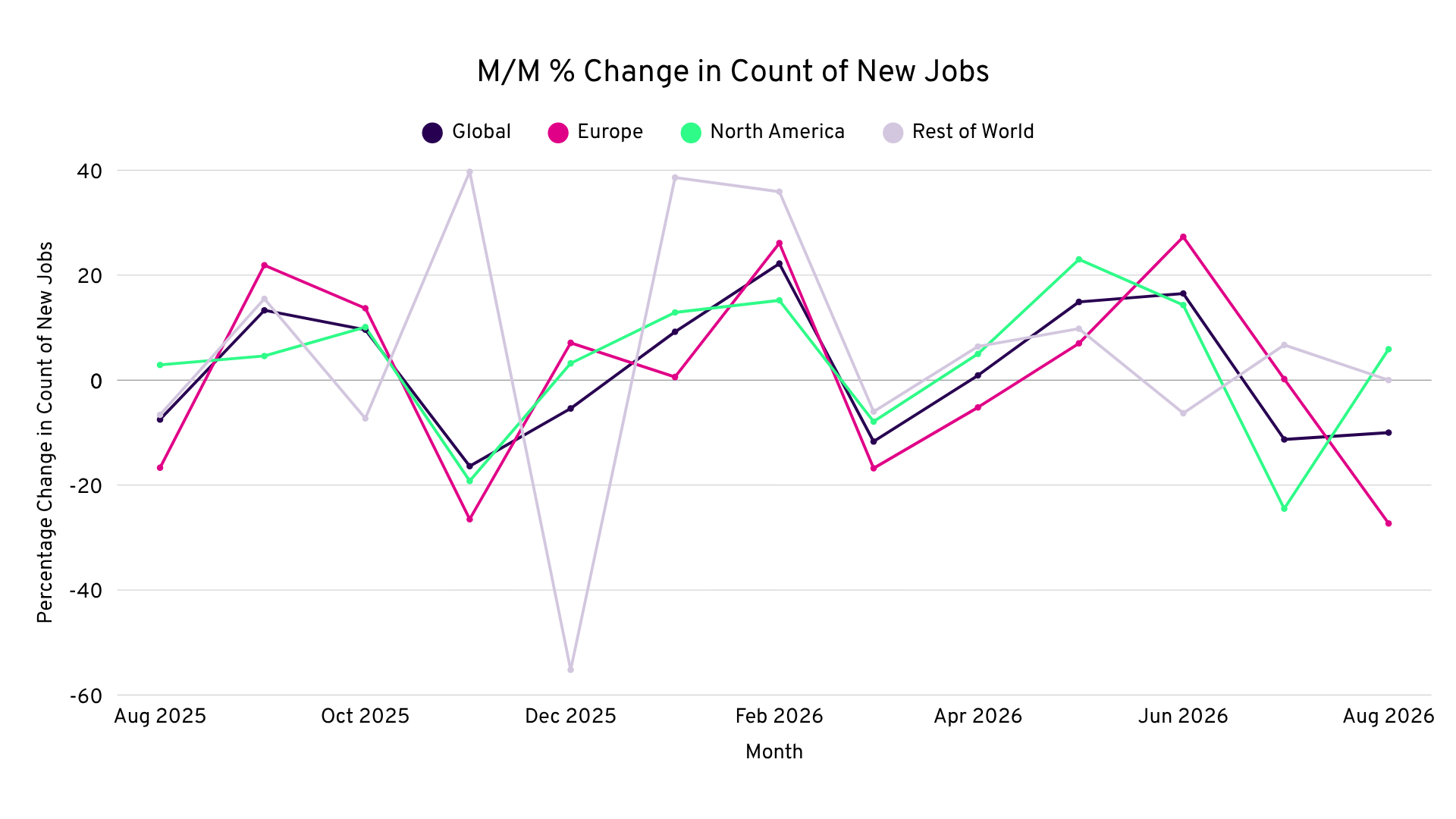
Finally, Table 4 explains why these monthly changes can look dramatic even when longer-run momentum remains supported. Over the prior 13 months, global month-to-month changes have repeatedly swung—for example, 2026-06 +16.5%, followed by 2026-07 -11.3%, and then 2026-08 -10.0%. Europe shows a similarly volatile pattern, including 2026-07 +0.2% before 2026-08 -27.3%. This volatility is a practical reminder for hiring managers: monthly posting counts are operationally sensitive (requisition timing, approval cycles, project start dates), so workforce strategy should be calibrated using both short-term signals and the trailing 12-month measure.
August 2026 delivered a global decline in new quantum job postings (-10.0%), driven primarily by Europe (-27.3%), with stability in the Rest of World and modest growth in North America. At the same time, the trailing 12-month trend remains positive across all regions (Table 3), and Table 4 confirms the underlying pattern is volatile—making a balanced, multi-horizon approach the most reliable way to guide hiring and policy-oriented workforce planning.
| Region | M/M Change |
|---|---|
| GLOBAL | -10.0% |
| EUROPE | -27.3% |
| NORTH AMERICA | 5.9% |
| REST OF WORLD | 0.0% |
| *REPORTING MONTH: August 2026 |
| Region | M/M Change |
|---|---|
| GLOBAL | -11.3% |
| EUROPE | 0.2% |
| NORTH AMERICA | 24.5% |
| REST OF WORLD | 6.7% |
| *REPORTING MONTH: July 2026 |
| Region | M/M Change |
|---|---|
| GLOBAL | 1.8% |
| EUROPE | 0.6% |
| NORTH AMERICA | 2.6% |
| REST OF WORLD | 2.8% |
| *REPORTING MONTH: August 2026 |
The QTech Workforce Monitor Report compiles data from publicly announced job openings within the quantum technology sector. This report is published monthly on the QED-C Blog. The next update will be available after October 5, 2026