

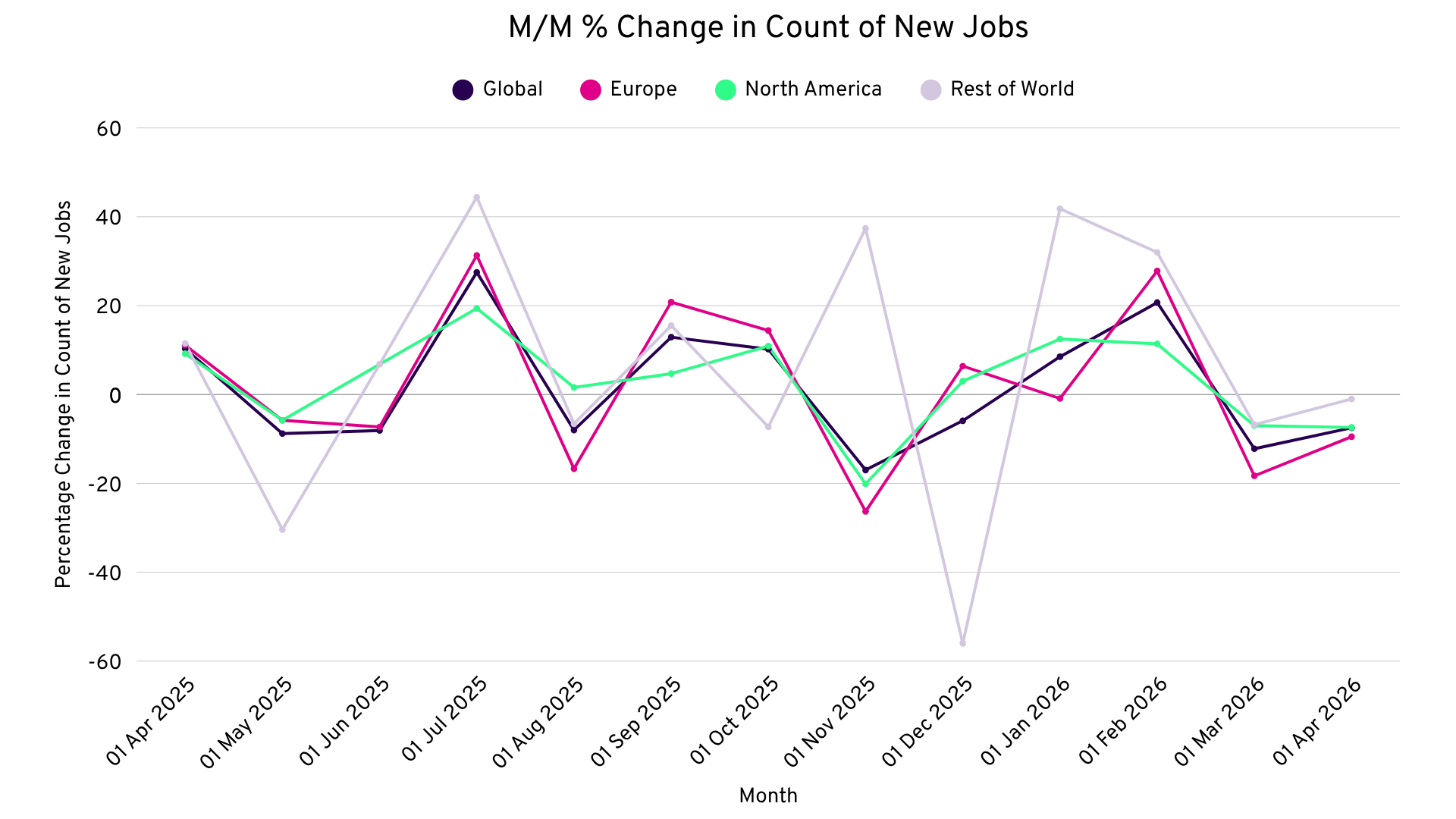
The number of new job postings for the Quantum Technology industry was lower in April 2026 on a month-over-month basis. As shown in Table 1, new job postings in April fell by 7.5% globally. Declines were also recorded across the major regions: Europe -9.5%, North America -7.4%, and Rest of World -1.0%. In practical terms, this indicates fewer new roles were posted during the April reporting window compared with March.
Table 2 provides the month-to-month context for the immediately preceding period. In March 2026 (final report), global postings declined by 12.2%, with declines across all regions as well: Europe -18.3%, North America -7.0%, and Rest of World -6.8%. Taken together, Tables 1 and 2 show consecutive soft months in terms of new posting volume—i.e., fewer roles were posted in March and again in April.
Looking beyond short-term activity, Table 3 shows how the trailing 12-month count of new postings is changing for April 2026. The global trailing 12-month measure is +0.8%, indicating that across the longer horizon the ecosystem is approximately stable with a slight positive bias. Europe remains slightly negative (-0.3%), North America is modestly positive (+1.3%), and the Rest of the World is more clearly positive (+3.4%). This pattern—near-flat 12-month change alongside weaker month-to-month results—suggests that the declines in Tables 1 and 2 are more consistent with near-term variation in posting activity than with a broad structural contraction in new demand.
For interpreting month-to-month variation, Table 4 is the most informative reference. The global row shows that across the prior 13 months the monthly percentage changes have swung meaningfully in both directions (for example, 2026-02 +20.7% followed by 2026-03 -12.2%, and then 2026-04 -7.5%). This volatility is a reminder that monthly posting counts can be sensitive to timing and hiring cycles—such as when employers open requisitions, how quickly approvals convert into listings, and how project schedules and funding activity translate into hiring—while the 12-month measure smooths those effects.
Implications for HR, hiring managers, and startup CEOs
April 2026 shows a decline in the volume of new job openings versus March (Table 1), following a deeper decline in March versus February (Table 2). However, the trailing 12-month trend for April remains slightly positive globally (Table 3), and Table 4 explains why month-to-month changes can appear substantial even when the broader trajectory is comparatively stable.
| Region | M/M Change |
|---|---|
| GLOBAL | -7.5% |
| EUROPE | -9.5% |
| NORTH AMERICA | -7.4% |
| REST OF WORLD | -1.0% |
| *REPORTING MONTH: April 2026 |
| Region | M/M Change |
|---|---|
| GLOBAL | -12.2% |
| EUROPE | -18.3% |
| NORTH AMERICA | -7.0% |
| REST OF WORLD | -6.8% |
| *REPORTING MONTH: March 2026 |
| Region | M/M Change |
|---|---|
| GLOBAL | 0.8% |
| EUROPE | -0.3% |
| NORTH AMERICA | 1.3% |
| REST OF WORLD | 3.4% |
| *REPORTING MONTH: April 2026 |
The QTech Workforce Monitor Report compiles data from publicly announced job openings within the quantum technology sector. This report is published monthly on the QED-C Blog. The next update will be available after June 5, 2026