

The number of new job postings for the Quantum Technology industry was slightly lower in May 2026 on a month-over-month basis. As shown in Table 1, global new postings declined by 1.1%. Regionally, Europe -1.0% and North America +0.1% were near flat, while the Rest of World decreased by 5.2%, indicating comparatively weaker new opening activity in that region during the May reporting window.
This May result follows a broader soft patch reflected in the latest final figures. Table 2 shows that in April 2026 the global count of new postings fell by 4.2%. Declines were also recorded across the main regions—Europe -6.2%, North America -4.7%—while the Rest of World rose 4.4% in April. Together, Tables 1 and 2 suggest that May continued a cautious tone for new openings globally, with regional direction diverging between the Rest of World and the larger developed markets.
To assess whether month-to-month changes are translating into longer-horizon movement, Table 3 reports the trailing 12-month count of new jobs. For May 2026, the global trailing 12-month change is +1.1%. Europe and North America are both +0.5% and +1.1%, respectively, while the Rest of World is higher at +3.7%. For decision-makers, this combination—slightly negative in the current month (Table 1) but positive over the trailing 12 months (Table 3)—points to a market that remains modestly supported over time, even if new posting flow is uneven from month to month.
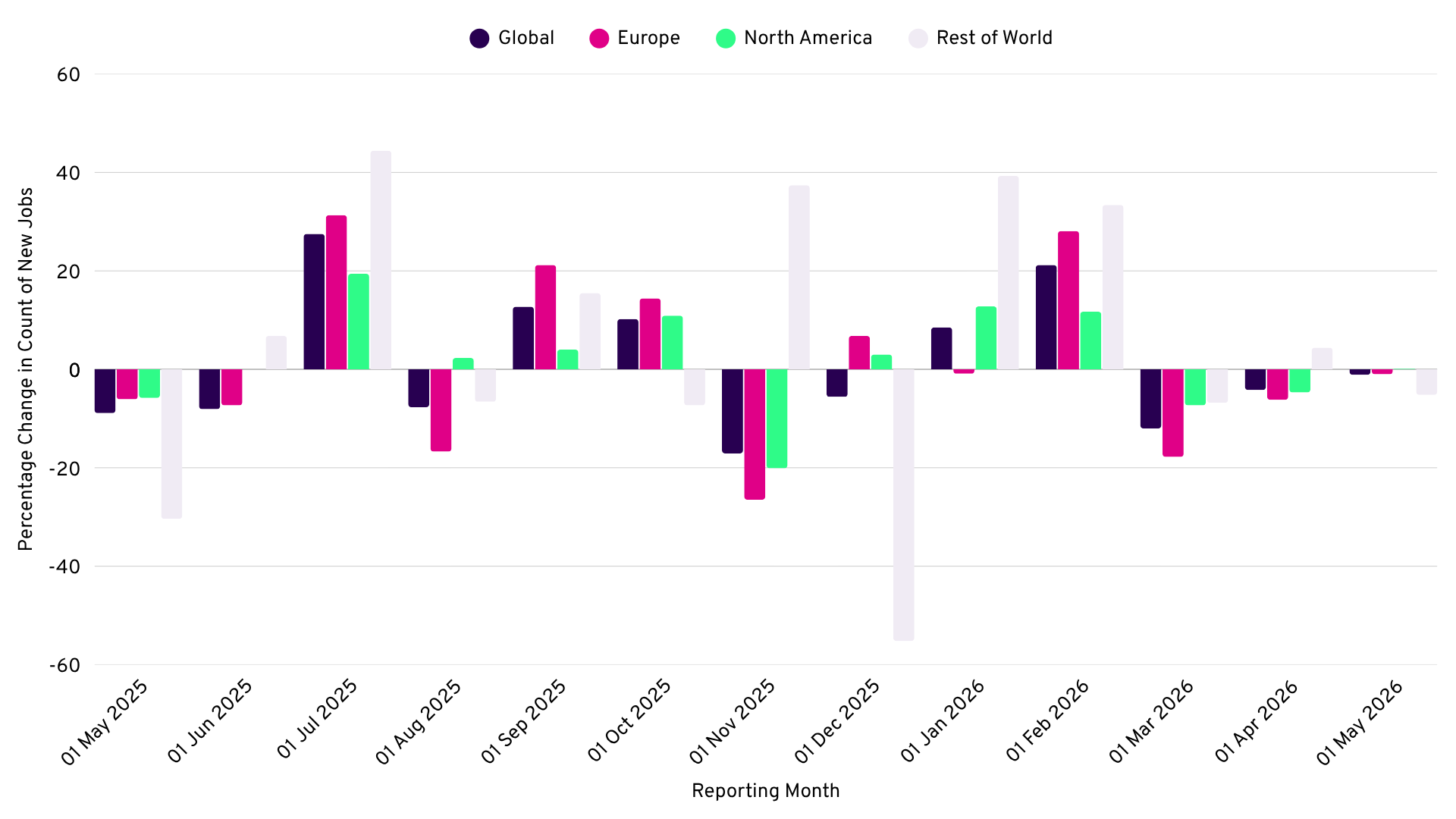
Table 4 provides the underlying month-to-month volatility over the prior 13 months. The global series shows multiple sizable swings, including 2025-11 -17.1%, a recovery in 2026-02 +8.5% and 2026-03 +21.2%, and then a pullback through 2026-04 -4.2% and 2026-05 -1.1%. This pattern is important for workforce planning: it indicates that “direction” in a single month can be misleading, and that policy and hiring guidance should be based on sustained movement across several months rather than one reporting window.
May 2026 shows a modest global decrease in new job postings (Table 1) after a larger April contraction (Table 2). However, the trailing 12-month trend remains positive globally (Table 3), and Table 4 confirms that month-to-month variation has been substantial over the past year—reinforcing the need for multi-month, not single-month, interpretation.
| Region | M/M Change |
|---|---|
| GLOBAL | -1.1% |
| EUROPE | -1.0% |
| NORTH AMERICA | 0.1% |
| REST OF WORLD | -5.2% |
| *REPORTING MONTH: May 2026 |
| Region | M/M Change |
|---|---|
| GLOBAL | -4.2% |
| EUROPE | -6.2% |
| NORTH AMERICA | -4.7% |
| REST OF WORLD | 4.4% |
| *REPORTING MONTH: April 2026 |
| Region | M/M Change |
|---|---|
| GLOBAL | 1.1% |
| EUROPE | -0.5% |
| NORTH AMERICA | 1.1% |
| REST OF WORLD | 3.7% |
| *REPORTING MONTH: May 2026 |
The QTech Workforce Monitor Report compiles data from publicly announced job openings within the quantum technology sector. This report is published monthly on the QED-C Blog. The next update will be available after July 5, 2026