

By: QED-C Law and Policy TAC
Contributing Members: Fred Qiu and Glenn Kesselman

On May 21, 2026, the U.S. Department of Commerce announced the signing of nine letters of intent to provide approximately $2.013 billion in federal incentives under the CHIPS and Science Act to support the domestic quantum industry. The planned awards include $1 billion for IBM to establish a new quantum foundry subsidiary focused on quantum-grade superconducting wafers, $375 million for GlobalFoundries to establish a secure domestic quantum foundry supporting multiple quantum modalities, and additional funding for seven quantum computing companies (ATOM Computing, Diraq, D-Wave, Infleqtion, PsiQuantum, Quantinuum, & Rigetti) pursuing neutral atom, silicon-spin, superconducting, photonic, and trapped-ion technologies. According to the Department, the initiative is intended to strengthen U.S. leadership in quantum computing and accelerate progress toward utility-scale, fault-tolerant quantum computers. Notably, the two largest awards are directed toward domestic manufacturing infrastructure, signaling a policy emphasis not only on quantum computing systems, but also on the manufacturing capabilities needed to support long-term industry growth and scaling.
As with other incentives provided under the CHIPS and Science Act, the funding is expected to be accompanied by various requirements and guardrails intended to advance U.S. economic and national security objectives. These may include restrictions relating to foreign entities of concern, limitations on certain collaborations and investments involving sensitive countries, reporting obligations, and other compliance requirements. For quantum companies, the announcement underscores the increasing intersection between quantum technology development and broader national security, supply chain, and industrial policy considerations.
The initiative also continues a broader trend in how the federal government supports strategically important technologies. In addition to providing funding, the Department announced that it will receive minority, non-controlling equity stakes in recipient companies as a condition of the awards. This approach differs from traditional research and development contracts and procurement programs and aligns government support more closely with the long-term success of quantum technologies. Government ownership interests can introduce additional considerations relating to corporate governance, information-sharing, reporting obligations, future financing transactions, and potential exit mechanisms. For quantum companies and investors, the initiative may signal a future in which government support is increasingly accompanied by longer-term strategic relationships rather than traditional funding awards alone. More broadly, the initiative represents another example of the federal government utilizing targeted investments and public-private partnerships to strengthen domestic capabilities in industries viewed as important to U.S. competitiveness, technological leadership, and industrial resilience.
On May 22, 2026, French President Emmanuel Macron announced an additional €1 billion investment in France’s quantum strategy through the France 2030 investment program. The funding is intended to support continued development of domestic quantum capabilities and forms part of France’s broader effort to strengthen technological sovereignty and reduce dependence on foreign technologies. The announcement reflects a broader trend of governments treating quantum technologies as strategic national assets and using public-private partnerships to support domestic innovation and commercialization.
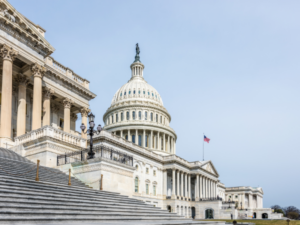
On April 29, 2026, the House Committee on Science, Space, and Technology approved H.R. 8462, the National Quantum Initiative Reauthorization Act. The bill would reauthorize and modernize key federal quantum research and development programs, strengthen coordination among federal agencies, support workforce development, expand collaboration with allies, and increase support for quantum applications and infrastructure. The original National Quantum Initiative Act was enacted in 2018 and expired in the fall of 2023, making reauthorization a significant priority for the quantum community.
The House bill now awaits consideration by the full House of Representatives, while a separate Senate bill (S. 3597) has been approved by the Senate Commerce Committee and awaits consideration by the full Senate. If enacted, the legislation would provide an updated framework for federal quantum research, commercialization, and workforce initiatives. The bill also reflects a broader policy shift toward accelerating commercialization, workforce development, and deployment of quantum technologies while continuing to support foundational research.
According to reports, the White House is preparing an executive order that would establish deadlines for the adoption of post-quantum cryptography (PQC) across federal agencies. Under the reported draft, agencies would be required to migrate key-establishment functions to PQC by December 31, 2030, and transition digital signatures used in high-impact systems and high-value assets by December 31, 2031. The draft order would also apply to certain covered contractors, potentially expanding PQC migration obligations beyond the federal government itself.
If issued, the order would mark a significant shift from planning and inventory efforts toward implementation and deployment of PQC technologies. For federal agencies, contractors, and technology providers, the proposed deadlines may increase the importance of identifying affected systems, assessing migration pathways, and preparing for broader adoption of quantum-resistant security technologies.
On May 7, 2026, the Department of War (DOW) issued a proposed rule that would significantly expand Foreign Ownership, Control, or Influence (FOCI) disclosure and mitigation requirements. Historically, FOCI reviews have largely been limited to contractors performing classified work. Under the proposed rule, DoD would extend these requirements to unclassified contracts and subcontracts valued above $5 million, potentially affecting more than 37,000 entities. Contractors would be required to disclose beneficial ownership information, report foreign ownership and control relationships, and implement mitigation measures where DOW identifies national security risks. The rule implements Section 847 of the FY2020 National Defense Authorization Act, which directed DoD to strengthen its process for assessing and mitigating FOCI risks across the defense industrial base.
Although not specific to quantum technologies, the rule could have important implications for the quantum industry, where many companies accept government funding or are developing products for civil and military markets. If finalized, the rule could increase scrutiny of foreign ownership interests and governance rights and may encourage quantum companies seeking to sell to DOW to evaluate ownership structures, investment arrangements, and compliance processes earlier in their growth and fundraising cycles. Comments on the proposed rule are due July 6, 2026.