Reports

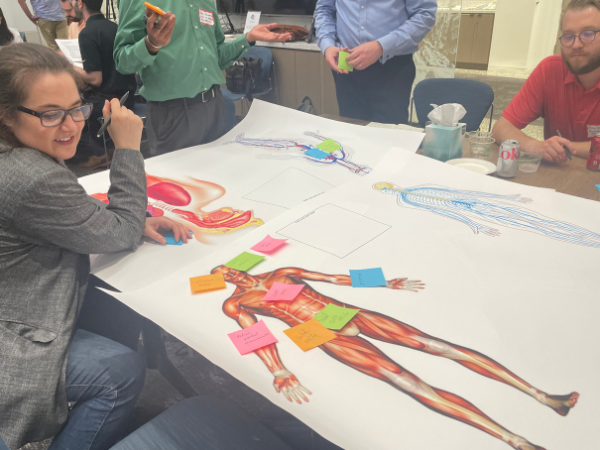
Woman looking at human musculature diagram
Biomedical sensing faces challenges ranging from biological, physical, and chemical complexity and noisy environments to regulatory requirements and clinical implementation. Quantum sensing offers several compelling solutions to these challenges that could provide important benefits over classical tools.
The demand for precise and reliable position, navigation, and timing (PNT) information has driven innovation in increasingly advanced measurement tools for centuries, and the importance of these systems in today’s highly interconnected, technology-dependent world has never been higher.
Lock on credit card on keyboard
The financial industry depends on secure messaging in transactions sent between banks, merchants, customers, and government agencies; credit card authorizations; wire transfers; account information; and other types of communications.
Man flipping pages of a report
Quantum technology can provide benefits and risks to cybersecurity. Quantum key distribution (QKD), first described by Charles Bennett and Gilles Brassard in 1984, is the basis for secure encryption based on the principles of quantum mechanics.
Quantum computing (QC) offers intriguing solutions to supply chain, transportation, and logistics problems that classical computers cannot completely solve. It also offers the possibility of significantly faster computations, with applications in all modes of the transportation and logistics industry — air, land, and sea.

The practical application and commercialization of NV diamond materials for quantum systems has both opportunities and challenges as it looks at scaling up capabilities.
This report details an overview of the current state of QIST at the HBCUs. It also contains recommendations on how to more effectively engage underrepresented students with a focus on increased engagement at the HBCU Schools of Engineering.
The report estimates QC market size at US$848 million in 2023 with robust expansion expected over the next three years.
The quantum industry is advancing rapidly and need for qualified talent at all levels is growing; while efforts are underway to prepare students at the undergraduate, masters, and PhD level for quantum engineering and scientist roles, there are few associate degree and certificate-level programs geared toward training technicians
Photonic Integrated Circuits (PICs) and opto-electronic integration are critical to enable and advance quantum systems. Optimized for quantum technologies, PICs would equip those technologies with new capabilities; improve performance; and reduce their size, weight, power and cost (SWaP-C), and thereby accelerate the market for emerging quantum products.

Supply Chain Framework Report

The resulting framework organizes technology components and materials according to a view of the quantum stack, which includes key supply chain elements for quantum technologies such as computing, sensing and metrology, and communications and networking.